, exact location withheld
What to Put in an Urbex First Aid Kit
Start with the ANSI Z308.1 workplace kit list, then add what abandoned buildings call for, from bleeding control to tweezers, with sources for each item.
The best starting point for an urbex first aid kit is the standard workplace kit, ANSI/ISEA Z308.1, in the Class B version if you want one built for higher risk. Then you add the things abandoned buildings actually call for, which are bleeding control, eye flushing, soap and water, tweezers and dry clothes.
This is entertainment, not medical advice, and no kit replaces training or a 911 call. Every item here links to the agency or university it came from, and none of it is a reason to go inside anything. I’m not recommending a specific kit or brand, because none of that is on my gear list and I won’t invent specs.
What’s in a standard first aid kit?
A lot less than people assume, and it’s all basic. OSHA’s rule for workplaces says only that adequate first aid supplies shall be readily available. The agency then points to ANSI Z308.1 as an example of the minimal contents of a generic first aid kit.
The University of Texas at Austin’s safety office posts the contents of a Class A kit, the one meant for most workplaces. The list is, in the quantities the standard gives:
- 16 adhesive bandages, 1 by 3 inches
- 1 roll of adhesive tape
- 10 antibiotic applications and 10 antiseptic applications
- 1 breathing barrier
- 1 burn dressing and 10 burn treatment applications
- 1 cold pack
- 2 eye coverings and 1 ounce of eye and skin wash
- 2 pairs of medical exam gloves
- 1 roller bandage
- 2 sterile pads and 2 trauma pads
- 1 triangular bandage
- 1 pair of scissors, hand sanitizer and a first aid guide
That’s the floor, and it’s built for the common injuries. It isn’t built for a fall through a floor, which is why the standard has a second class.
Should it be a Class A or a Class B kit?
Class B is the closer match for an abandoned building. The same University of Texas page lists a Class B kit for higher risk environments, and it adds a tourniquet and a splint, raises most of the quantities, and gives you 4 pairs of gloves, 4 trauma pads and 4 ounces of eye wash.
OSHA draws the line itself. In a 2019 letter it says general industry workplaces need the bleeding control items listed for Class A kits, and that workplaces with a high risk of serious injury must also have Class B kits, which add tourniquets. It strongly recommends Class B for construction, which it describes as high risk.
I’m not saying an explorer is a construction worker. An abandoned building does share the things that put construction on that list, which are falls, edges and sharp debris with nobody maintaining any of it. The dangers post leads with floors for that reason. If the worst thing that can happen is a deep cut or a bad fall, the kit built for that is the better pick.
What should you add to the box?
Bleeding control comes first. OSHA says the standard method is to apply direct pressure to the bleeding site until the bleeding stops, and that tourniquets should be used when direct pressure does not control severe external limb bleeding. Stop the Bleed teaches a pull, twist and clip method, with the tourniquet placed between the wound and the torso.
Eyes come next. OSHA’s rule says that where a person’s eyes may be exposed to injurious corrosive materials, suitable facilities for quick flushing must be provided. The animal hospital I explored had a bottle of formaldehyde on a shelf, and eye wash is already in the standard kit.
Two items already in the standard kit deserve a second look. The Class A list includes a breathing barrier, and NIOSH’s cold first aid says that if a hypothermia victim has no pulse, begin CPR. A barrier does nothing without someone who knows CPR, which is the training point again. On bleeding, Stop the Bleed adds that if a tourniquet doesn’t control it, a second one can go above the first.
The rest follows the hazards in this series.
- Soap and water for a needlestick. NIOSH’s first step is to wash needlesticks and cuts with soap and water. The full steps are in Needles and Sharps in Abandoned Buildings.
- Fine tipped tweezers for a tick. CDC says to grasp the tick as close to the skin’s surface as possible using clean fine tipped tweezers, pull away from the skin with steady, even pressure, and not use petroleum jelly, heat or nail polish.
- An epinephrine autoinjector if you’ve had a severe reaction to stings. NIOSH says workers with a history of severe allergic reactions to insect stings should carry an epinephrine autoinjector, and that is a prescription item between you and your doctor.
- Dry clothes for the cold. NIOSH’s first aid for trench foot is to remove shoes or boots and wet socks, and OSHA’s first aid for hypothermia is to remove any wet clothing and replace it with dry clothing. See Exploring Abandoned Buildings in Winter.
- Something to drink for the heat. NIOSH says heat exhaustion first aid is to remove the worker from the hot area and give liquids to drink. The other side is in Exploring Abandoned Buildings in Summer Heat.
Does the kit matter more than the training?
No, and OSHA says so in plain language. The workplace rule says a person or persons shall be adequately trained to render first aid when there’s no infirmary, clinic or hospital in near proximity. That’s the point of the phrase. A tourniquet is a very good object in the hands of someone who has practiced putting one on.
The 2019 letter goes further and says first aiders must be trained on current bleeding control methods to be adequately trained. Stop the Bleed runs through pressure, tourniquets and calling 911, and its message is simple. Pressure stops bleeding.
Whatever is in the kit, the first move for anything serious is the phone. The kit is for the minutes before help arrives.
How do you keep a kit ready?
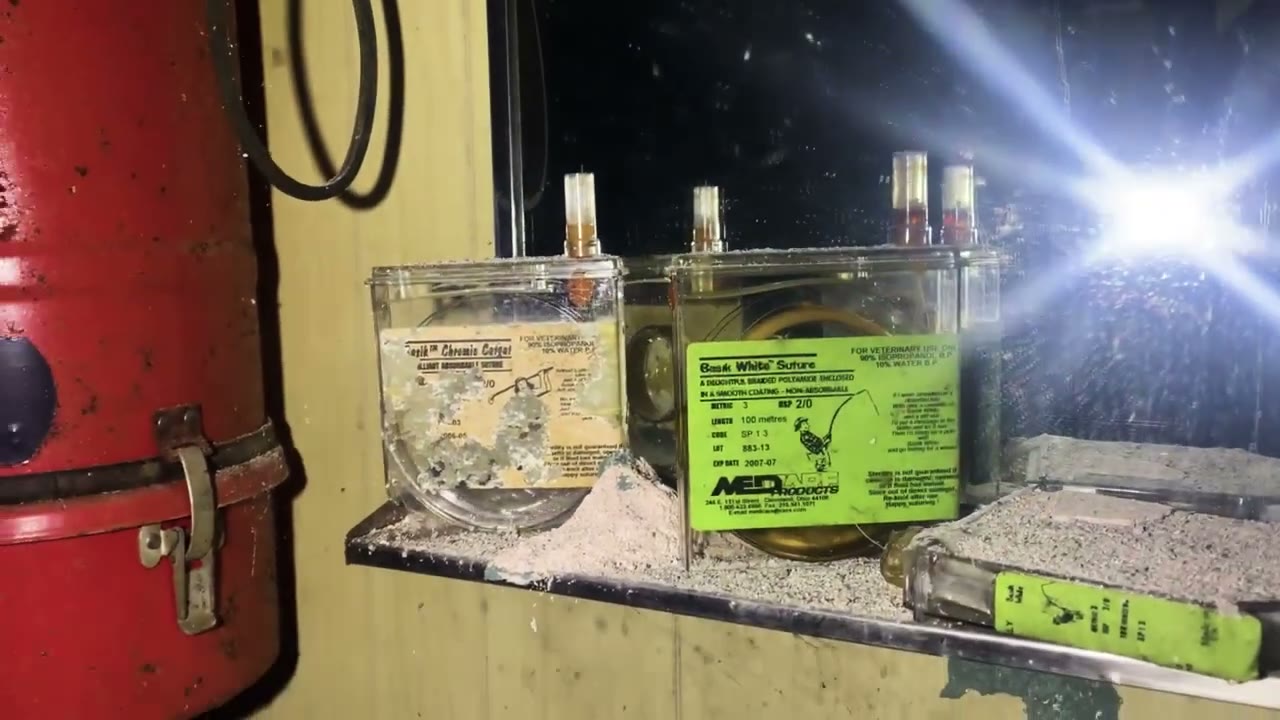
Check it. The University of Texas page says first aid supplies shall be inspected frequently and replenished when necessary and notes that some supplies have expiration dates. OSHA’s appendix tells employers to assess their needs periodically and augment the kit. The suture label in the photo above shows how that goes.
Then think about where it lives. A kit you can’t reach is no use, and the backpack is where gear usually ends up. The LHI 45L tactical backpack is on my gear list. What matters is that the kit lives in the same place every time, so the person with you knows where it is.
What does this look like on a real explore?
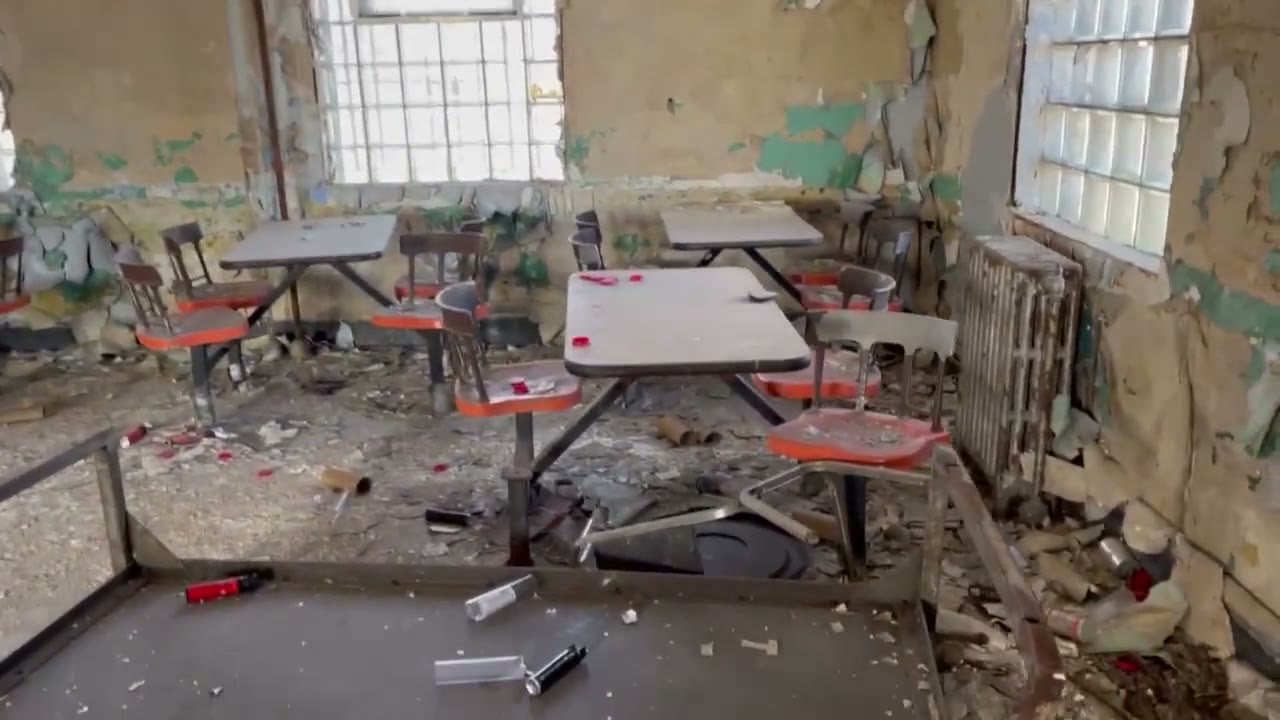
It looks like supplies you can’t use. The Illinois hospital had exam gloves and vinyl gloves left behind, and the Indiana animal hospital had a shelf of suture packs, one with an expiration date in 2007. Medical stuff in abandoned buildings isn’t a kit. It’s old stock of unknown condition, and it sits next to the needles.
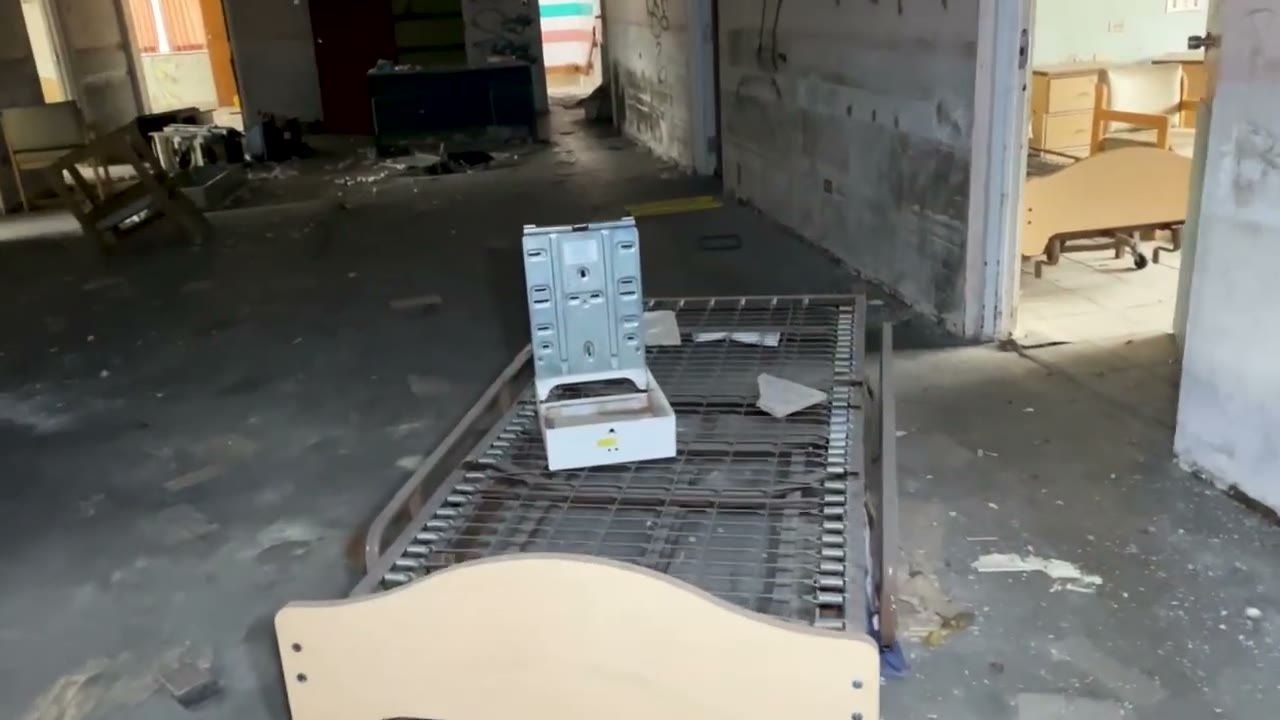
How I stay safe on explores is in my guide, How to Find Abandoned Places. The Illinois hospital and the prison are worth watching with a kit in mind.
Pack the kit before you need it, and take the class before you use it.
What I carried in
Same list as every video description.
Sources
- 1910.151 Medical Services and First Aid, OSHA, accessed Nov 4, 2026
- 1910.151 App A First Aid Kits Non Mandatory, OSHA, accessed Nov 4, 2026
- First Aid for Bleeding Control, OSHA Interpretation Letter, Jun 19, 2019
- First Aid Kit, Environmental Health and Safety, University of Texas at Austin, Feb 19, 2024
- Stop the Bleed, Uniformed Services University, accessed Nov 4, 2026
- Needlestick Injuries Are Preventable, NIOSH, Feb 1, 2021
- What to Do After a Tick Bite, CDC, Jun 9, 2026
- Fast Facts Stinging Insects, NIOSH, 2010
- Cold Stress, OSHA, Feb 17, 2023
- Cold-related Illnesses in Workers, NIOSH, Mar 3, 2026
- Heat-related Illnesses, NIOSH, Mar 3, 2026
- Poisonous Plants and Work, NIOSH, Oct 1, 2026
More like this


The footage that never goes public lives on Patreon. It's paid, and it's where the rough cuts, the security run-ins and the early releases go.