, exact location withheld
Elevator Shafts, Stairwells and Open Drops in Abandoned Buildings
What OSHA, NIOSH and the U.S. Fire Administration say about elevator shafts, stairs and floor holes, and why abandoned buildings lack the required protection.
An elevator shaft, a stairwell and a hole in a floor are the same problem. Each one is a drop with nothing in front of it, and OSHA’s fall rules exist because a fall of 6 feet or more is serious enough to require a guardrail, a net or a harness. Nobody installs or maintains any of those in an abandoned building.
This is entertainment, not safety or legal advice, and none of it is a reason to go inside anything. Every number below links to the agency or report it came from.
How far is a dangerous fall?
Farther than most people guess, and the rules draw the line low. For construction, OSHA requires protection for any employee on a surface with an unprotected side or edge 6 feet or more above a lower level, using guardrails, safety nets or personal fall arrest systems. Holes get their own rule. A worker has to be protected from falling through a hole more than 6 feet up by a cover, a guardrail or a fall arrest system, and from tripping or stepping into any hole by a cover.
Other buildings use an even lower number. For general industry, OSHA’s walking and working surfaces rule sets the trigger at 4 feet for both unprotected edges and holes, and holes below 4 feet still need a cover or a guardrail so nobody trips or steps into them.
The reason for all of this is on OSHA’s own page. It says falls are the leading cause of fatalities in the construction industry. The standards also say what a guardrail has to survive. OSHA’s criteria call for a top rail about 42 inches above the walking level, give or take 3 inches, and for a system that holds up under a force of at least 200 pounds applied near the top edge. Keep that in mind the next time a loose railing in an old stairwell looks like it will take your weight.
Why is an elevator shaft so dangerous?
Because a door is not proof that a floor is on the other side of it. Two reports from NIOSH’s Fatality Assessment and Control Evaluation series make the point.
In 1990 a warehouseman in New Jersey fell 70 feet through an open elevator shaft. He had left the elevator door open on the seventh floor while a coworker used the same elevator to go to the eighth. With the car gone from his floor, the opening was unguarded, and he stepped backward into it. The investigators recommended that freight elevators have an interlock that keeps the car from moving while its doors are open.
The second report is closer to this blog’s subject. In 1991 a maintenance inspector was checking an unoccupied office building for damage. The report says he apparently opened the hoistway door on the fourth floor and fell 36 feet down the shaft while looking into it. The investigators recommended that owners of unoccupied buildings take elevators properly out of service so nobody can enter or use them, and that people who work alone have a way to call for help. A building that has been empty for years has probably not had either done.
Working buildings are not safe from it either. In April 2024 a 23 year old man in Joliet died after falling into an elevator shaft while moving cabinets, and OSHA announced it was investigating. That was a place with power, employees and a business running. The U.S. Fire Administration’s guide for evaluating vacant buildings lists open shafts and pits among the hazards its own teams are told to look for, and its safety section lists “unprotected holes or shafts” as a potential hazard.
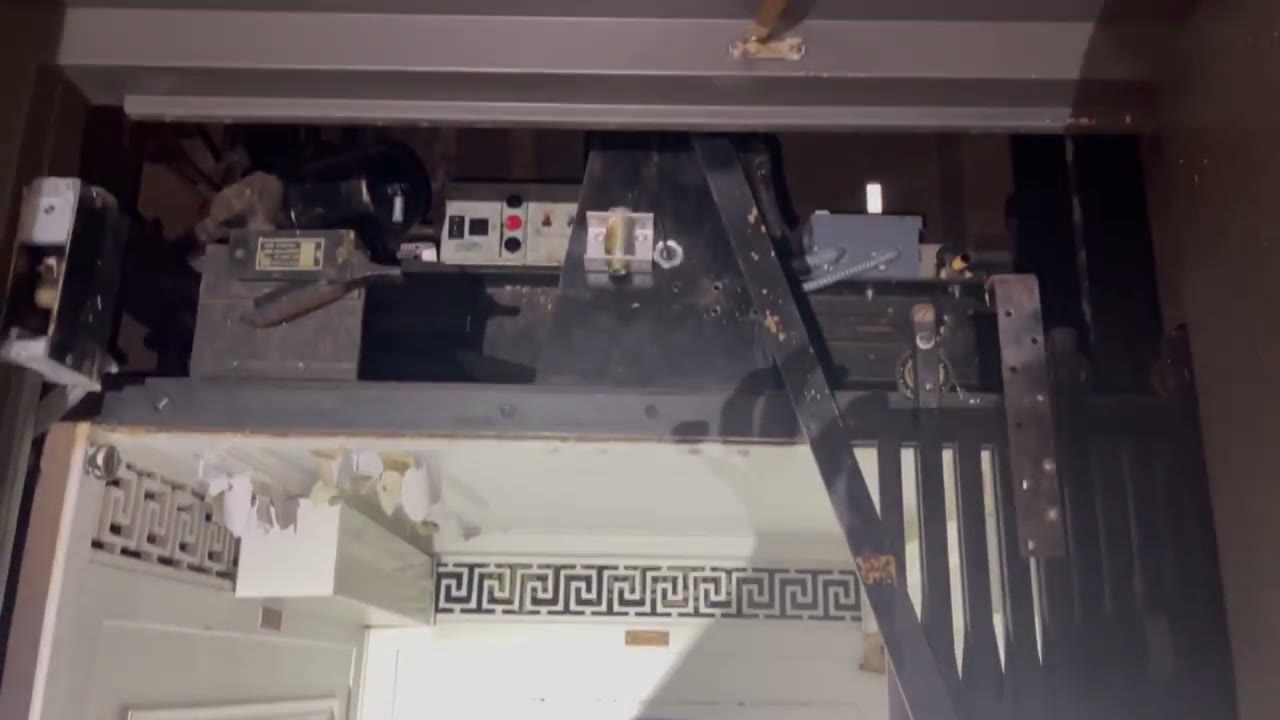
In the bank video I called it an extremely old elevator, tiny inside. What the frame shows is the equipment sitting above the car, which is the part of an elevator nobody thinks about until a door is open. I’m not saying anything about what is behind any elevator door in any building, because I don’t know, and that is the lesson of both reports.
What makes a stairwell risky?
Stairs are built to be predictable, and abandoned stairs stop being predictable. OSHA’s construction rule for stairways says a stair with four or more risers, or one that rises more than 30 inches, needs at least one handrail. Handrails are to sit between 30 and 37 inches high, and a stair rail installed after March 15, 1991 has to be at least 36 inches above the tread. Both are tested against a force of at least 200 pounds. The rule also says riser height and tread depth must be uniform within a flight.
That last rule matters most, because your feet learn a flight of stairs by the second step. For general industry, OSHA’s rule asks for stair rails and handrails on every flight with at least 3 treads and 4 risers, and for a guardrail or stair rail along a landing edge that is 4 feet or more above the level below.
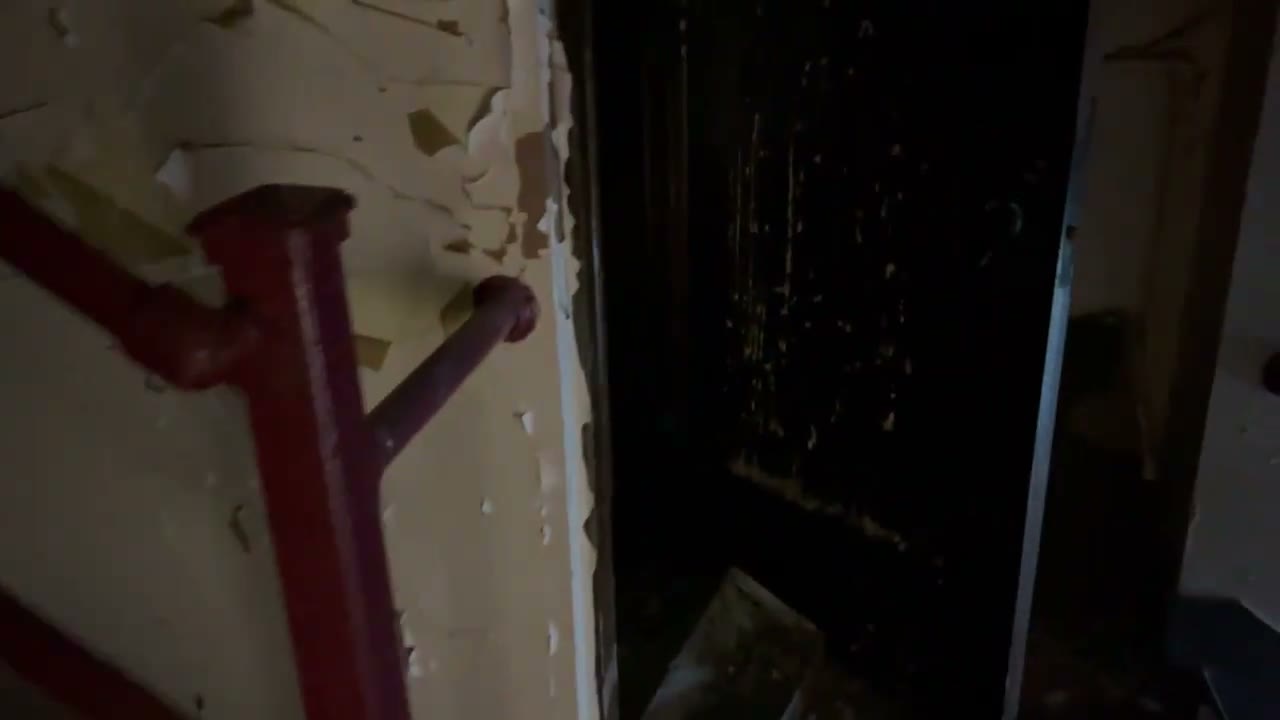
Now picture the same stair after twenty years of leaks and no inspection. The rail is loose or gone, treads have rotted, and the uniform steps your feet expect are no longer uniform. At Gilroy Stadium in Gary, Indiana, a step had come off a stairway and so had the next one, which meant skipping a step. In the Greek Orthodox church in Detroit the stairs to the second floor were a little hidden, and at the top someone says “whoa, there’s a huge hole, that’s scary.” Neither of those had a sign or a barrier.

What about holes in the floor and the covers over them?
A cover only works if somebody built it to work. OSHA’s criteria say a cover has to support at least twice the weight of the employees, equipment and materials that could be on it at one time, has to be secured so wind, equipment or people can’t displace it, and has to be color coded or marked with the word “HOLE” or “COVER.” OSHA’s construction guidance adds that floor holes should be guarded or covered as soon as they are created, and that on existing structures the opening should be guarded or covered immediately once someone finds it.
Now compare that with a sheet of plywood lying across a gap in an abandoned building. Nobody checked it against twice the load, nobody fixed it down, and nothing marks it. There is no way to tell from above whether it will hold.
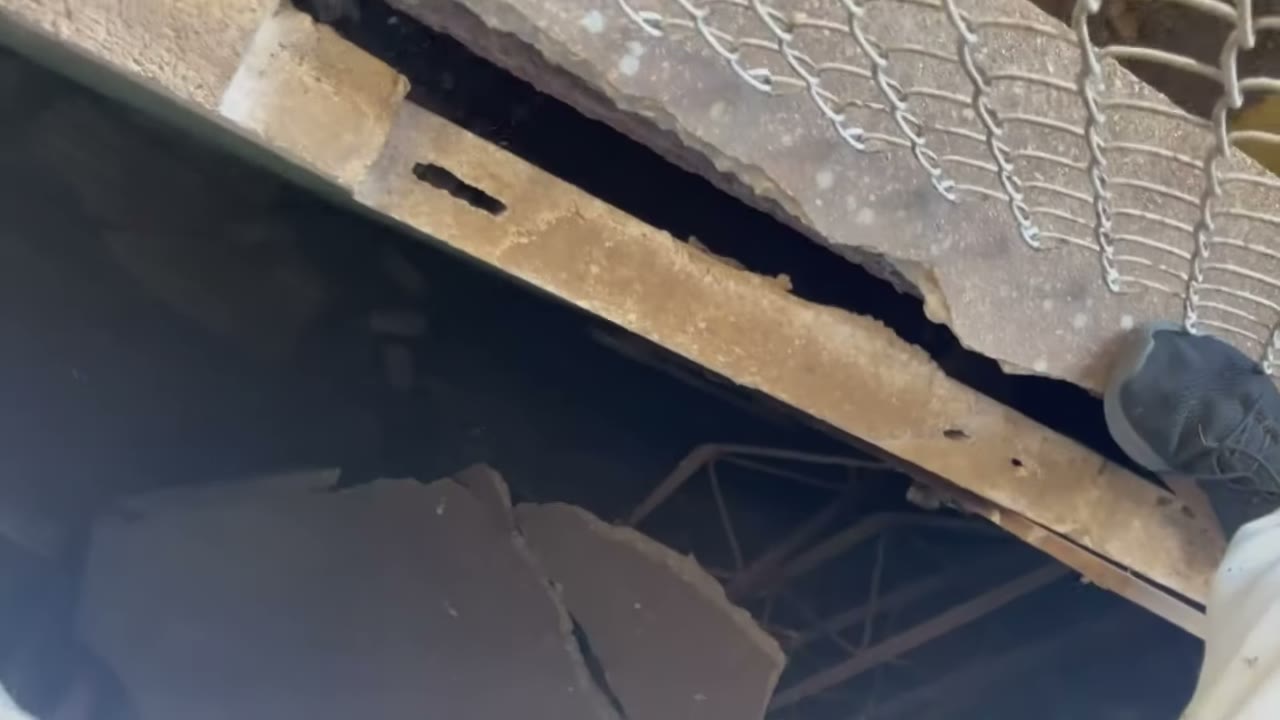
The U.S. Fire Administration’s vacant building guide lists holes in floors, missing stairs and open shafts and pits as hazards, and says vandals can do damage like cutting holes in floors and walls. At Gilroy Stadium a section of concrete had simply fallen in, and the video has the line “you can see chunks of cement.”
For more on how floors fail before the hole shows up, read signs a floor in an abandoned building could collapse.
Does darkness make it worse?
Yes, and agencies that study it say so plainly. NIOSH’s mining program says slip and fall hazards can be more difficult to detect in low light, and that for 2016 through 2021 slips or falls were the second leading class of nonfatal lost time injuries at underground mines, at 5,532 injuries, or about 25 percent. That is a different workplace, but it is the same physics. An edge you can’t see is an edge you find with your foot.
The U.S. Fire Administration makes the same point about firefighters, noting that holes in floors are especially dangerous when visibility is low. Its own PPE list for people evaluating vacant buildings includes a flashlight. Most flashlights, including brand ones, aren’t bright enough, which is why I carry one good light, and the best flashlight guide and the best headlamp guide explain what to look for. A bright light also changes the problem. A beam shows the floor in front of you and nothing about the floor ten feet past it, so slow down at every doorway, every landing and every place where the floor goes dark.
What does this look like in practice?
It looks like nothing, which is the problem. In the bank video the elevator is a small door with machinery above it. At the stadium the gap is a crack in a slab with steel showing underneath. In the churches and schools it’s a stair with a missing step or a rail that isn’t what it was. None of it announced itself, and none of it had a guardrail, a cover or a sign.
How I find places, stay safe and film without burning locations is in my guide, How to Find Abandoned Places. For the wider list of hazards, start with what’s actually dangerous inside abandoned buildings, and for the legal side read is urban exploring illegal.
A drop you can’t see the bottom of is a drop nobody has measured, so treat every dark edge as one.
What I carried in
Same list as every video description.
Sources
- 1926.501 Duty to have fall protection, OSHA, accessed Nov 4, 2026
- 1926.502 Fall protection systems criteria and practices, OSHA, accessed Nov 4, 2026
- 1910.28 Duty to have fall protection and falling object protection, OSHA, accessed Nov 4, 2026
- 1926.1052 Stairways, OSHA, accessed Nov 4, 2026
- Construction Falls, OSHA, accessed Nov 4, 2026
- Warehouseman Falls 70 Feet to His Death Through an Open Elevator Shaft in New Jersey, NIOSH FACE 90NJ010, Apr 11, 1991
- Maintenance Inspector Dies After Falling 36 Feet Down an Elevator Shaft, NIOSH FACE 91NJ021, Jan 7, 1992
- 23 year old man killed after falling into elevator shaft in Joliet identified, OSHA investigating, ABC7 Chicago, Apr 11, 2024
- Basic Evaluation Procedures for Abandoned and Vacant Buildings, U.S. Fire Administration, Apr 2018
- Illumination, NIOSH Mining, accessed Nov 4, 2026
More like this


The footage that never goes public lives on Patreon. It's paid, and it's where the rough cuts, the security run-ins and the early releases go.