, exact location withheld
Drone Rules for Filming Abandoned Places
FAA, Illinois and Chicago rules that apply before you fly a drone near an abandoned building, plus what the FAA says about indoor flights and money.
Two sets of rules apply when you fly a drone near an abandoned building in the United States. The FAA writes the rules for the sky, and states, cities and property law write the rules for the ground and the space just above it. Meeting one set does not satisfy the other.
This is entertainment and general information, not legal advice. Nothing here makes it fine to enter, or fly over, a property you have no right to be on.
What does the FAA require before you fly?
For a hobby flight, a short list. The FAA’s page for recreational flyers says you are required by law to take TRUST and carry proof when flying. A drone that weighs 250 grams (0.55 pounds) or more has to be registered, and Penn State’s course notes on the FAA rules say registration lasts three years. Drones that need a registration number also have to broadcast Remote ID, unless they fly inside an FAA recognized identification area.
Then come the flight rules. The FAA says to keep the drone within visual line of sight and to fly at or below 400 feet in Class G, which is uncontrolled airspace. In Class B, C, D and surface Class E airspace you need prior FAA authorization through LAANC or DroneZone. The Illinois Department of Transportation says controlled airspace in Illinois is generally within 5 miles of an airport or heliport. That matters if you are anywhere near Chicago, which has two big ones.
Remote ID is the rule most people skip. The FAA describes it as the ability of a drone in flight to provide identification and location information, and says it helps authorities locate the control station when a drone seems to be flying unsafely or in a restricted area. You can meet it with a drone built to broadcast, with an add on broadcast module, or by flying inside an FAA recognized identification area.
Does a YouTube channel turn a hobby flight into a business flight?
The FAA’s own definition is narrow. Recreational flying is flying for enjoyment and not for work, business purposes, or for compensation or hire. The FAA lists three ways to fly for work, business or other non recreational reasons. They are following the Small UAS rule, Part 107, getting an exemption under 49 U.S.C. 44807, or getting an airworthiness certificate for the aircraft.
Neither page mentions posting videos, so I won’t tell you where the line falls for a channel that earns money. Read the definition and decide, or ask the FAA. If the answer is Part 107, the FAA says you need a remote pilot certificate with a small UAS rating and must be at least 16. The FAA says you may not fly over people unless they are directly participating in the operation. Daytime flight runs from 30 minutes before sunrise to 30 minutes after sunset, and twilight flight needs anti collision lighting.
What do Illinois and Chicago add?
Local law covers what the FAA leaves alone. The FAA and the Department of Transportation published a fact sheet saying state and local laws on trespass on property are generally not preempted. It says laws may restrict drone operations in the immediate reaches of a property when they substantially interfere with the owner’s use and enjoyment. The FAA keeps exclusive authority over aviation safety and airspace efficiency at any altitude, and the fact sheet says a privacy ban over an entire city would very likely be preempted.
Illinois criminal trespass applies on the ground. A person commits it by knowingly and without lawful authority entering or remaining within or on a building, or by entering the land of another after notice that entry is forbidden. Launching from a public spot doesn’t fix a flight that crosses a line the law cares about. Illinois also has a recording statute that covers recording a person in their residence from outside it with a device that transmits from a remote location. The text does not mention drones, and how it applies would depend on the facts.
Chicago has its own drone ordinance. ABC7 reported in November 2015 that the City Council approved a 400 foot ceiling, a ban on flying directly over a person or another person’s property, and limits near airports, churches, schools, hospitals and police stations without consent, with fines of $500 to $5,000. The Chicago Sun-Times reported in 2019 that the ordinance bars flying near O’Hare and Midway, near schools, hospitals, open air stadiums, police stations and places of worship, and over private property without permission. The alderman who sponsored it said his office got maybe one drone complaint a month, and operators said police gave inconsistent answers. These are news reports, not the code. Check the current text before you fly.
A lot of the buildings I film are churches, schools and hospitals, which are the same types that ordinance names.
Can you fly a drone inside an abandoned building?
The FAA says its rules don’t reach indoors. Its FAQ answers that Part 107 would not apply to operations conducted indoors and that FAA rules apply to operations conducted outdoors in the National Airspace System. Note that the question on that page is about commercial flights, so read it for what it says and nothing more.
An FAA rule that doesn’t apply indoors says nothing about whether you may be inside. That question belongs to the trespass statute above, and I wrote about it in Is Urban Exploring Illegal?. The building has not gotten safer either. A drone indoors still meets the holes, cables and falling ceilings I cover in What’s Actually Dangerous Inside Abandoned Buildings.
What about parks and public land?
Check before you go. The National Park Service director signed a policy memorandum on June 26, 2014 telling superintendents to prohibit launching, landing or operating unmanned aircraft on NPS lands and waters while a permanent rule was developed. The memo kept administrative uses for search and rescue, fire and science. That memo is more than ten years old, so treat it as the starting point and look up the current rule for any park or preserve.
Abandoned structures turn up in parks, forest preserves and other public land, and each has its own rules. A ruin being open to the public doesn’t mean the sky above it is.
Which drone can you still buy?
The FCC changed the market in late 2025. Its December 22, 2025 fact sheet says foreign produced drones and drone critical components were added to the Covered List and that covered equipment is banned from receiving new equipment authorizations. The same sheet says the action does not prohibit importing, selling or using device models the FCC previously authorized, and that it does not affect any drone you already own.
My gear list has the DJI Mini 5 Pro and the DJI Mavic 3 Cine, both linked at the bottom of this page. I can’t tell you whether a given model is affected, so check the FCC’s current list before you buy. For how I compare drones for scouting, see The Best Drone for Scouting Abandoned Places.
What does this look like in practice?
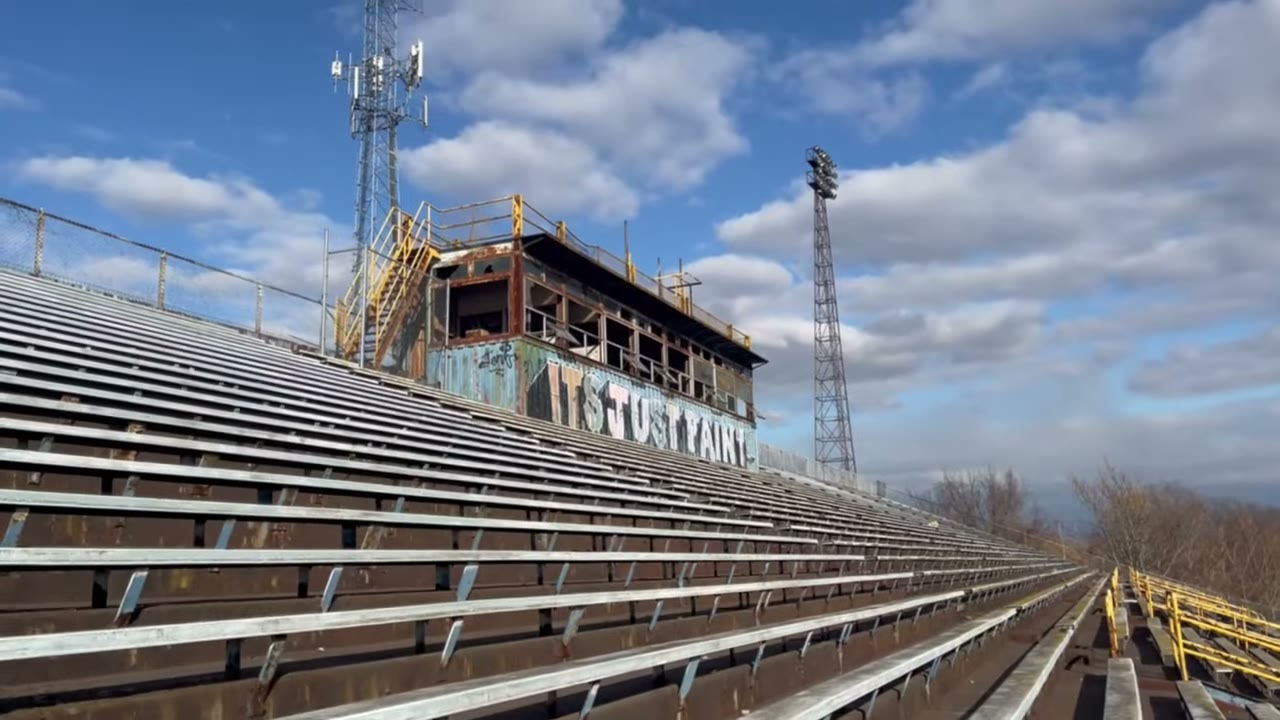
Look at what a drone would be looking at. The stadium frame above has a floodlight tower over a rusty press box. Gilroy Stadium has stands, a press box and light towers, and I said in the video that one of those towers looks like it collapsed. A drone near a tower is a drone near a bad day.
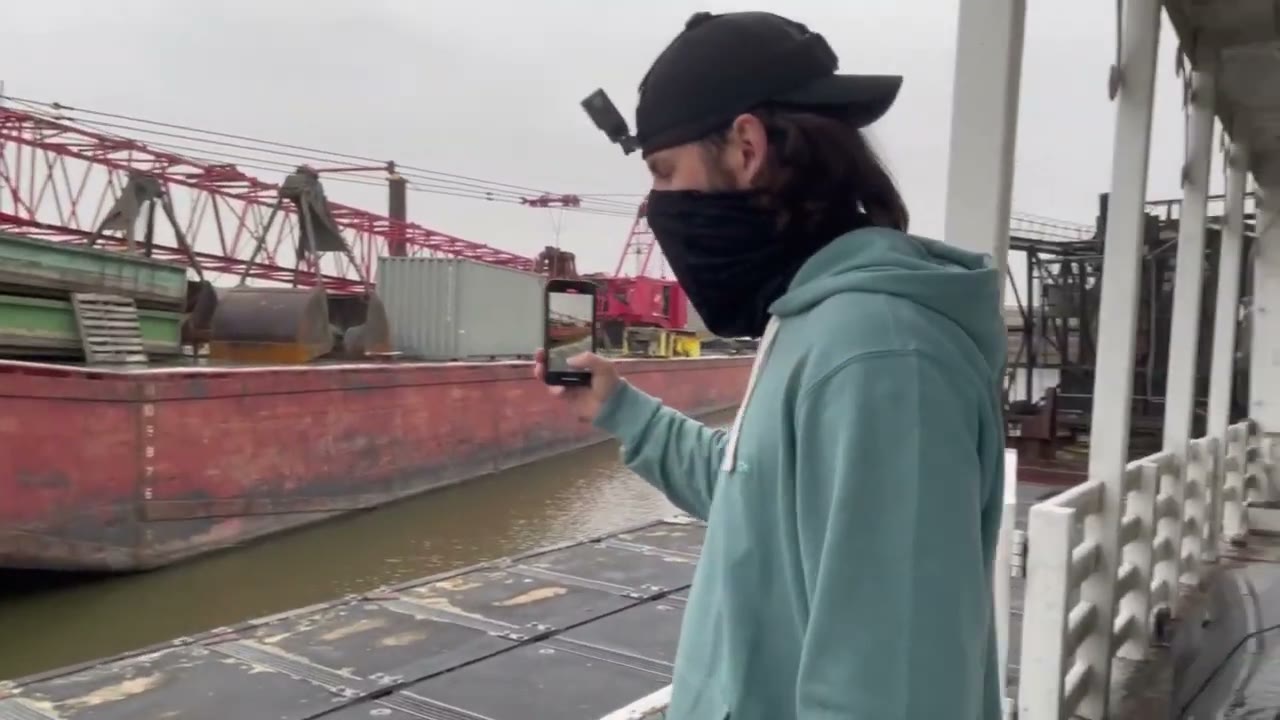
The casino boat is a working waterfront. In the frame below one of us films a red barge and cranes from the deck, and when we were there it was busy enough that we couldn’t step onto the deck without being seen from the surrounding businesses. A drone over that spot would have been in plain view of the same businesses.
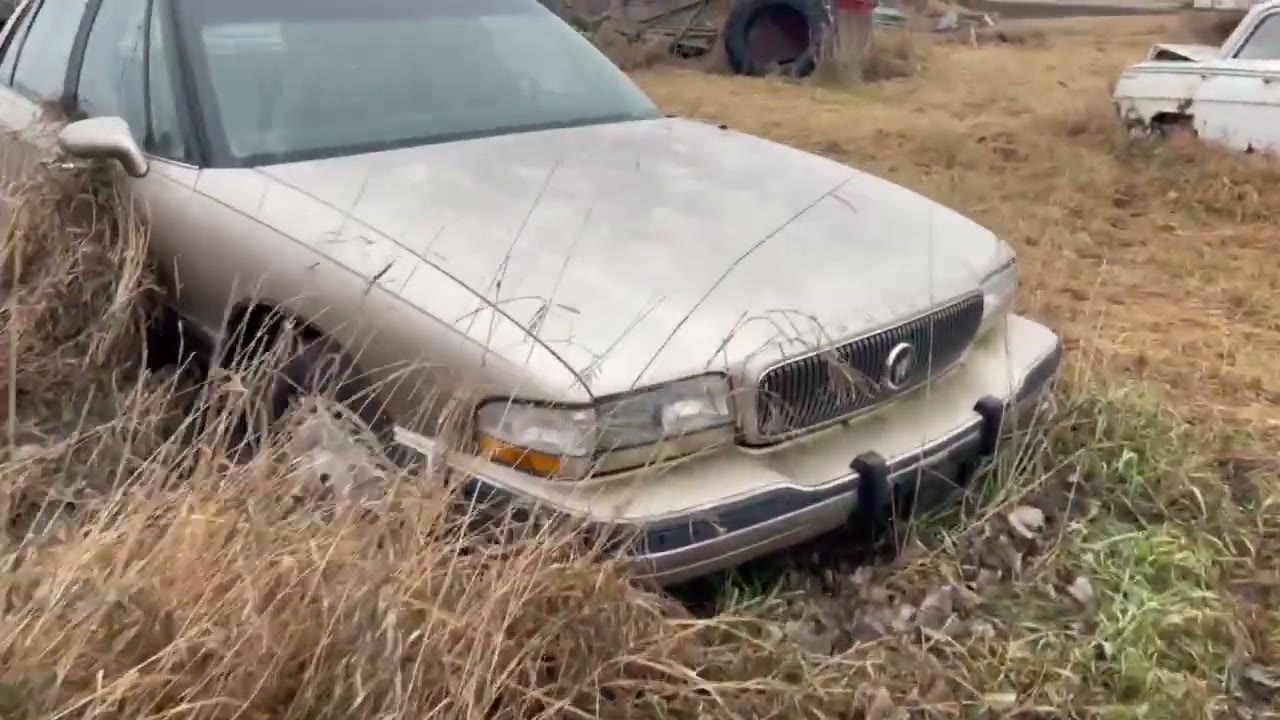
The farmhouse yard full of classic cars is the one where a drone seems most natural, since a wide shot shows the whole lot. It is also a case where location is the issue. I hide most locations on purpose, and an aerial shot of a yard shows roads, roofs and the shape of the land that a viewer can match to a map.
How I plan shots without burning locations is in my guide, How to Find Abandoned Places.
Check the sky, the owner and the city, in that order, before the props spin.
What I carried in
Same list as every video description.
Sources
- Recreational Flyers and Community Based Organizations, Federal Aviation Administration, Oct 29, 2026
- Remote Identification of Drones, Federal Aviation Administration, Mar 19, 2025
- Small Unmanned Aircraft Systems (UAS) Regulations (Part 107), Federal Aviation Administration, Jul 6, 2026
- What Is the Definition of Recreational or Hobby Use of a UAS or Drone, Federal Aviation Administration
- How Do I Fly a UAS or Drone for Work or Business Purposes, Federal Aviation Administration
- Do the FAA Rules and Regulations Apply to a Commercial UAS or Drone Operations Conducted Indoors Only, Federal Aviation Administration
- State and Local Regulation of Unmanned Aircraft Systems (UAS) Fact Sheet, FAA and U.S. Department of Transportation, Jul 14, 2023
- Unmanned Aircraft Systems, Illinois Department of Transportation
- FAA Regulations for Recreational Drone Use in United States, Penn State College of Earth and Mineral Sciences
- Chicago Drone Regulations Approved by City Council, ABC7 Chicago, Nov 18, 2015
- Chicago's Drone Law Pits Residents' Privacy Concerns Against Hobbyists Looking for a Place to Fly, Chicago Sun-Times, Jul 7, 2019
- 720 ILCS 5/21-3 Criminal Trespass to Real Property, Illinois General Assembly
- 720 ILCS 5/26-4 Unauthorized Video Recording and Live Video Transmission, Illinois General Assembly
- Unmanned Aircraft To Be Prohibited in National Parks, National Park Service, Jun 26, 2014
- FACT SHEET FCC Updates Covered List to Include Foreign UAS and UAS Critical Components, Federal Communications Commission, Dec 22, 2025
More like this


The footage that never goes public lives on Patreon. It's paid, and it's where the rough cuts, the security run-ins and the early releases go.