, exact location withheld
Centralia, the Town on Fire
Centralia, Pennsylvania has had a coal fire under it since 1962. How it started, the $42 million buyout, the residents who stayed, and what the state says.
Centralia is a small Pennsylvania borough in Columbia County where an underground coal fire has burned since May 1962. The federal government paid residents to leave, the state condemned the remaining houses, and almost everyone is gone. A handful of people still live there under a 2013 settlement.
This is a history post about a real town with real residents. Parts of the ground there have collapsed, and gases come from cracks in it. I haven’t been to Centralia, and nothing here is a reason to go anywhere that isn’t yours to be.
How did the Centralia mine fire start?
With trash. The Pennsylvania Department of Environmental Protection’s 2008 report on the fire says it began as a surface fire when the borough council ignited trash in an abandoned strip mining cut. The burning trash ignited the Buck anthracite seam, and the fire spread along the seam into tunnels beneath the town. The state says it affects about 400 surface acres.
Other accounts are less sure. The Christian Science Monitor, in a 2010 piece, wrote that the fire began at the town dump in 1962 and that the exact cause is unknown. Either way, the accounts agree that burning trash met an exposed coal seam and the fire spread into the tunnels and shafts below the town.
Why didn’t anyone put it out?
They tried. The state’s chronology says state and federal governments spent $3.3 million between 1962 and 1978 to control the fire, with “limited results.” The Monitor counts eight attempts to extinguish it over two decades before officials gave up because the work was too expensive and the fire seemed to pose limited danger.
In 1983, a federal Office of Surface Mining study estimated it would take $663 million to extinguish the fire. Centralia had about 1,100 people in 1962, according to the state. The same year, severe subsidence damaged Route 61, and the state spent about $0.5 million to stabilize it. Earlier, from 1979 to 1982, the federal government acquired 34 affected properties and paid for a study of whether the fire could spread, and the state started an air quality monitoring program.
What happened in 1981?
On February 14, 1981, the ground opened under a 12 year old boy named Todd Domboski, according to the Monitor. He was cutting through a resident’s yard. He held on to a tree root until a cousin rescued him. Residents also reported toxic fumes, with some people passing out in their homes, and the Monitor says trees died and pavement buckled.
The state’s chronology shows what followed in the years after. Congress appropriated $42 million for voluntary acquisition and relocation in 1984. Between 1985 and 1991, 545 residences and businesses were acquired and their residents moved.
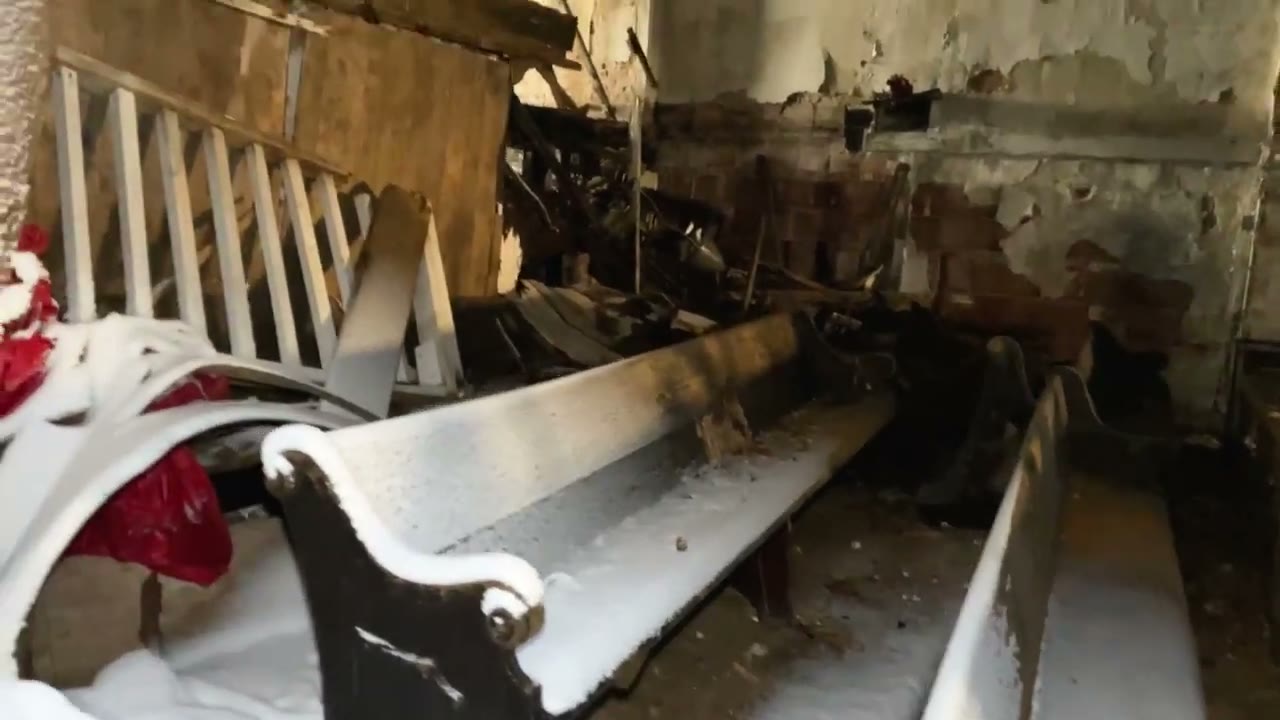
My own sinkhole church video in Gary, Indiana is not a mine fire, and I’m not comparing the two. It is a church that was close to collapse, with a floor that had sunk in and was held up in one spot by a single beam. It is a small picture of what ground that gives way does to a building.
What happened to the people who stayed?
Condemnation. The chronology says the Centralia Task Force used condemnation in January 1992 to acquire properties and relocate the remaining residents, and that condemnation was started against the remaining 53 properties. Route 61 was closed indefinitely. Courts ruled against the borough and against the property owners between 1993 and 1995. The Monitor reports that by 1990, 63 people remained, and the U.S. Postal Service eliminated Centralia’s ZIP code in 2002.
Then the holdouts took the state to federal court. The Associated Press reported in October 2013 that eight residents settled their lawsuit against state officials who were trying to evict them from condemned homes. Under the settlement, they may live in their homes for the rest of their lives, and the state paid $349,500 in total, $218,000 for the value of the homes and $131,500 to resolve other claims. A resident, Tom Hynoski, told the AP, “They bent us, but they didn’t break us.”
The residents argued that the fire posed little danger to their area and that officials and mining companies wanted to seize rights to billions of dollars of anthracite. State officials deny that and cite public safety.
Is Centralia dangerous now?
The state has measured it. In its 2008 study the state tested for carbon monoxide, sulfur dioxide, hydrogen sulfide, carbon dioxide and mercury. Carbon monoxide, sulfur dioxide and hydrogen sulfide stayed below their ambient air standards, and carbon dioxide never exceeded 576 ppm. Mercury vapor averaged about 1.6 nanograms per cubic meter at all three monitoring sites, far below the EPA reference concentration of 300. Those are readings at monitoring sites, so they say nothing about the air in a crack or a cellar. My guide on confined spaces and bad air explains why that difference matters.
The ground is a separate question. In 2012, a state geologist said the fire may have moved deeper underground but still threatens nearby homes by possibly opening new paths for gases. In February 2019 a state crew began filling a 100 foot sinkhole near Route 61. The state attributed it to mine subsidence on a different coal seam, and said it was unrelated to the fire.
What does a town that was bought out look like?
It looks like a street grid with the buildings removed. The AP says that by the end of the 1980s more than 1,000 people had moved and 500 structures had been demolished under the $42 million federal program. The same story says the site is now a tourist attraction, with an intact street grid, steam rising from cracked ground and the ruins of an abandoned highway. The state puts the relocation fund spending since 1983 at about $41.6 million, and the total cost of fire control and relocation at about $48.8 million. In January 2012, five property owners still had legal proceedings under way.
That is a different kind of abandoned place from the ones I film, where the building is still standing and everything is still inside. I’ve filmed a neighborhood in Illinois that, as I understood it, was prone to flooding, condemned and then demolished, and the houses are gone now. That is the Buddyville video. If you want a wider sense of how towns empty out, my guide to ghost towns covers it.
If you want to learn how I find places like these without burning them, and how I stay safe, it’s in my $9.99 guide, How to Find Abandoned Places. It doesn’t make trespassing legal, and I keep most of my locations private. A good light matters in places like this, and most flashlights, including brand name ones, aren’t bright enough. I carry one good one, the Coast XP11R on my gear list.
The fire under Centralia is still burning, and some of the people it didn’t move are still living above it.
What I carried in
Same list as every video description.
Sources
- Chronology, Pennsylvania Department of Environmental Protection, accessed Nov 4, 2026
- Centralia Mine Fire Mercury Study Final Report, Pennsylvania Department of Environmental Protection, Mar 10, 2008
- Centralia, Pa. How an underground coal fire erased a town, The Christian Science Monitor, Feb 5, 2010
- Pa. residents living above mine fire free to stay, KSL.com (Associated Press), Oct 31, 2013
- Officials Centralia sinkhole unrelated to underground fire, WHP CBS 21 (Associated Press), Feb 17, 2019
More like this


The footage that never goes public lives on Patreon. It's paid, and it's where the rough cuts, the security run-ins and the early releases go.