, exact location withheld
Why Chicago Has So Many Abandoned Buildings
Chicago has about 875,000 fewer people than in 1950, and its mills, schools and parishes closed too. A sourced look at why so many buildings sit empty.
Chicago has so many empty buildings because it has about 875,000 fewer people than it did in 1950, and the factories, schools and parishes that closed along the way left buildings their owners couldn’t sell or couldn’t afford to fix. They cluster on the South and West Sides, where redlining came first and the 2008 foreclosure crisis came later.
Entertainment and history, not legal advice. Every building in this post has an owner, and nothing here is an invitation to go inside one.
Did Chicago really lose that many people?
Yes. The Census Bureau counted 3,620,962 people in Chicago in 1950. The 2020 census counted 2,746,388. By my math that’s about 875,000 fewer, nearly a quarter of the 1950 total. The Tribune reported that the city’s population “topped out at 3.6 million in the 1950 census” and has “decreased in all but two of the seven decades since.”
The work left too. The Union Stock Yard completely stopped operating in 1971. Swift and Armour had already gone in the late 1950s, and the Encyclopedia of Chicago says the postwar highway system and the trucking industry “worked to disperse operations.” In Southeast Chicago, U.S. Steel’s South Works employed about 11,000 people in 1910. In 1983 the company said it would close the plant, which still employed 3,900 people. It closed for good in 1992. Between 1979 and 1986, about 16,000 Chicago area steelworkers lost their jobs.
The West Side lost its factories one at a time. WBEZ reported that manufacturing employed more than half a million workers in Chicago in 1960, and that by 2017 fewer than 9 percent of Chicagoans worked in it. Schwinn closed its bicycle factory in 1983. The Brach’s complex closed in 2003 and was demolished in 2014 after sitting dormant for more than 10 years.
What does redlining have to do with empty buildings?
Between 1935 and 1940 the federal Home Owners’ Loan Corporation produced maps of Chicago’s neighborhoods. WBEZ wrote in 2016 that “the maps show black neighborhoods drenched in red,” that the federal government “sanctioned disinvestment in black neighborhoods and urban centers,” and that “development was encouraged in the suburbs.”
In 2022 the Cook County Treasurer published a study called Maps of Inequality. Its finding was blunt. The study said “the overwhelming majority of vacant and abandoned properties that plague Chicago’s South and West sides” were “either redlined” or “drawn in yellow, meaning they were at risk of falling into the red category.” Redlined areas were the ones deemed hazardous for lending. That list includes many south suburbs and west suburban Maywood, so this isn’t only a city story.
That’s a pattern in the Treasurer’s data, not proof that redlining is the only cause. It’s one cause among several in this post, and the oldest.
What did the foreclosure crisis leave behind?
Zombies. The Woodstock Institute counted 217,035 residential foreclosures started in Cook County between 2008 and the end of 2012. It defined a zombie property as one with a foreclosure case filed but unresolved for more than three years. Of the foreclosures filed from 2008 to 2010, it found over 11,700 zombie properties in Cook County, including over 5,800 in Chicago. In plain terms, a foreclosure that was started and still wasn’t finished three years later.
Chicago has a rule for empty buildings. The Department of Buildings says a vacant building must be registered within 30 days, with a fee of $250 to $500, and the registration renewed every six months. The FAQ adds that “the City may seek significant fines and/or obtain authority to board-up or demolish the building.” It doesn’t say how many buildings are registered.
So how many are there? When WBEZ asked in 2013, the short answer was “no one knows.” The city said it didn’t have a list or know precisely how many vacant commercial properties were out there. What existed was complaints. There were more than 35,000 calls from people reporting vacant properties between 2010 and January 2013, covering about 24,000 properties.
The recent numbers are about land. The city says it owns approximately 10,000 parcels, “mostly on the South and West sides.” A 2024 study by Elevated Chicago and DePaul’s Institute for Housing Studies found more than 14,700 vacant lots close to a CTA train station as of July 2023. The Tribune reported that’s more than one third of the vacant lots in the city.
What happened to the closed schools and churches?
On May 22, 2013, the Chicago Board of Education voted, and it closed 50 schools. Ten years later, WBEZ and the Sun-Times found 26 of those buildings still vacant and unused. “More than half of the buildings aren’t back in use, most of them vacant and dilapidated,” they reported. CPS had 81,000 fewer students than it did a decade earlier. In May 2025 the district put 20 properties up for sale “once again,” mostly school buildings closed in 2013, and Chalkbeat reported that CPS spends between $100,000 and $150,000 a year to maintain and secure each vacant school.
The Archdiocese of Chicago consolidated too. Under Renew My Church it cut its parishes from 350 to 247. “Some parishes closed, some merged and others were turned into mission sites that are no longer used for mass.” St. Adalbert in Pilsen closed in 2019. An archdiocesan document described the church building as in “a very perilous state of repair,” and the archdiocese said neither it nor the parish could afford the $3 million in repairs.
Its schools went the same way. In January 2021 it announced it would close four, citing “low and steadily declining enrollment levels and large financial deficits,” including a combined 31% drop in enrollment over four years.
Why are suburban offices and malls empty now?
Some of the newest empties are in the suburbs. Allstate moved into its Northbrook campus in 1967, and by 2021 the campus held 2 million square feet of office space. That November it agreed to sell most of it to Dermody Properties for approximately $232 million. Allstate said in October that it would sell the headquarters, according to The Real Deal, “as about 95 percent of employees in Northbrook choose to work from home.” Dermody planned to demolish the campus and build 11 industrial buildings. By June 2026 it had finished the first phase, five warehouses totaling 1.2 million square feet, and the status of the remaining phases was unclear.
I made a video about that headquarters: Abandoned $232M Allstate Headquarters in Chicago. The $232M in the title is that sale price.
It isn’t only Allstate. JLL data reported by The Real Deal put office vacancy in the Chicago suburbs at 32.9 percent at the end of 2025, with a new all time high every quarter for five straight years. Since the start of 2020, suburban tenants have shed about 5.3 million square feet.
Malls are on the list too. Spring Hill Mall in West Dundee permanently closed in March 2024 after more than 40 years. West Dundee bought the property for $7 million, after spending $3.25 million to buy the former Sears and Macy’s storefronts.
What does this look like in practice?
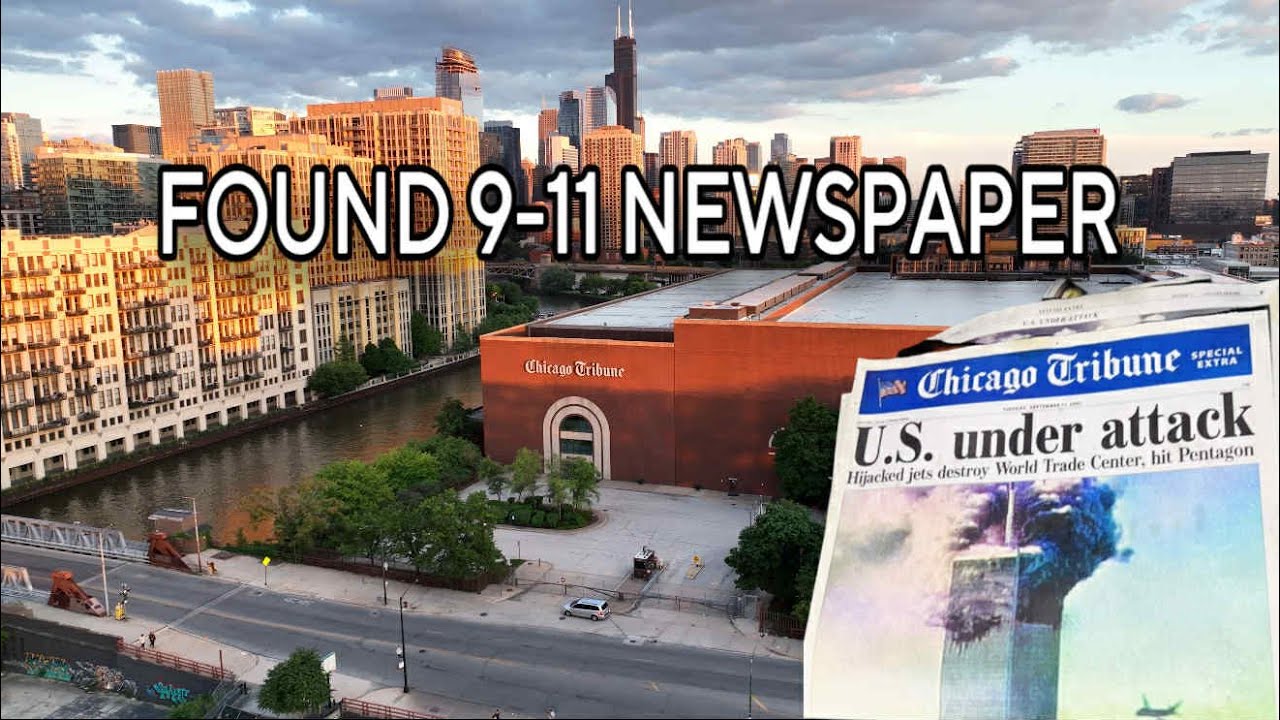
Each cause leaves a different kind of building. Videos of mine with Chicago in the title include the Allstate headquarters above, the Abandoned Chicago Tribune Newspaper Factory and We Found A Secret Mafia Car Hideout in Chicago. I’m not saying where the last two are. I hide most locations on purpose, so a spot labeled “Chicago” may not be in Chicago, and people always ask. I don’t give them out.
Empty isn’t the same as unowned. In the French mansion post the owner caught us, and Chicago expects a vacant building to be registered with the city. How I find my own spots, stay safe and film without burning locations is in a $9.99 PDF called How to Find Abandoned Places. The light I carry is linked at the bottom of this page. Most flashlights, including brand ones, aren’t bright enough, which is why I carry one good light.
What I carried in
Same list as every video description.
Sources
- Population of the 100 Largest Urban Places: 1950 (Table 18), U.S. Census Bureau, 1998
- Chicago's population grew slightly over the last decade, according to 2020 census, Chicago Tribune via Yahoo News, Aug 12, 2021
- Union Stock Yard, Encyclopedia of Chicago
- Iron and Steel, Encyclopedia of Chicago, 2005
- U.S. Steel Corp., Encyclopedia of Chicago
- More Than Jobs: What Chicago's West Side Lost When The Factories Closed, WBEZ, Oct 28, 2019
- New Redlining Maps Show Chicago Housing Discrimination, WBEZ, Oct 28, 2016
- Maps of Inequality: From Redlining to Urban Decay and the Black Exodus, Executive Summary, Cook County Treasurer, Jul 2022
- Unresolved Foreclosures: Patterns of Zombie Properties in Cook County, Woodstock Institute, Jan 2014
- Vacant Buildings FAQ, City of Chicago Department of Buildings
- How many vacant buildings are there in Chicago?, WBEZ, Jan 25, 2013
- City-Owned Land Inventory, City of Chicago
- Vacant lots near CTA pose challenges, but also opportunities: study, Chicago Tribune, Apr 1, 2024
- After 10 years, Chicago school closings have left big holes, and promises unkept, WBEZ and Chicago Sun-Times, Jun 1, 2023
- For sale: 20 old Chicago school properties, Chalkbeat Chicago, May 12, 2025
- The Archdiocese of Chicago has reduced its number of parishes by more than 100. Now what?, WBEZ, May 9, 2022
- Archdiocese of Chicago to close 4 schools, consolidate several South Side and suburban parishes, FOX 32 Chicago, Jan 22, 2021
- Allstate Inks $232M Deal to Sell Most of Campus in Illinois, Insurance Journal, Nov 29, 2021
- Buyer of Allstate campus seeks to build warehouses on site, The Real Deal, Nov 30, 2021
- Dermody sells portion of former Allstate HQ to Realty Income for $175M, The Real Deal, Jun 1, 2026
- Suburban Chicago office vacancies hit new high at year-end, The Real Deal, Jan 23, 2026
- What's next for Spring Hill Mall after its permanent closure?, NBC Chicago, Mar 23, 2024
More like this


The footage that never goes public lives on Patreon. It's paid, and it's where the rough cuts, the security run-ins and the early releases go.