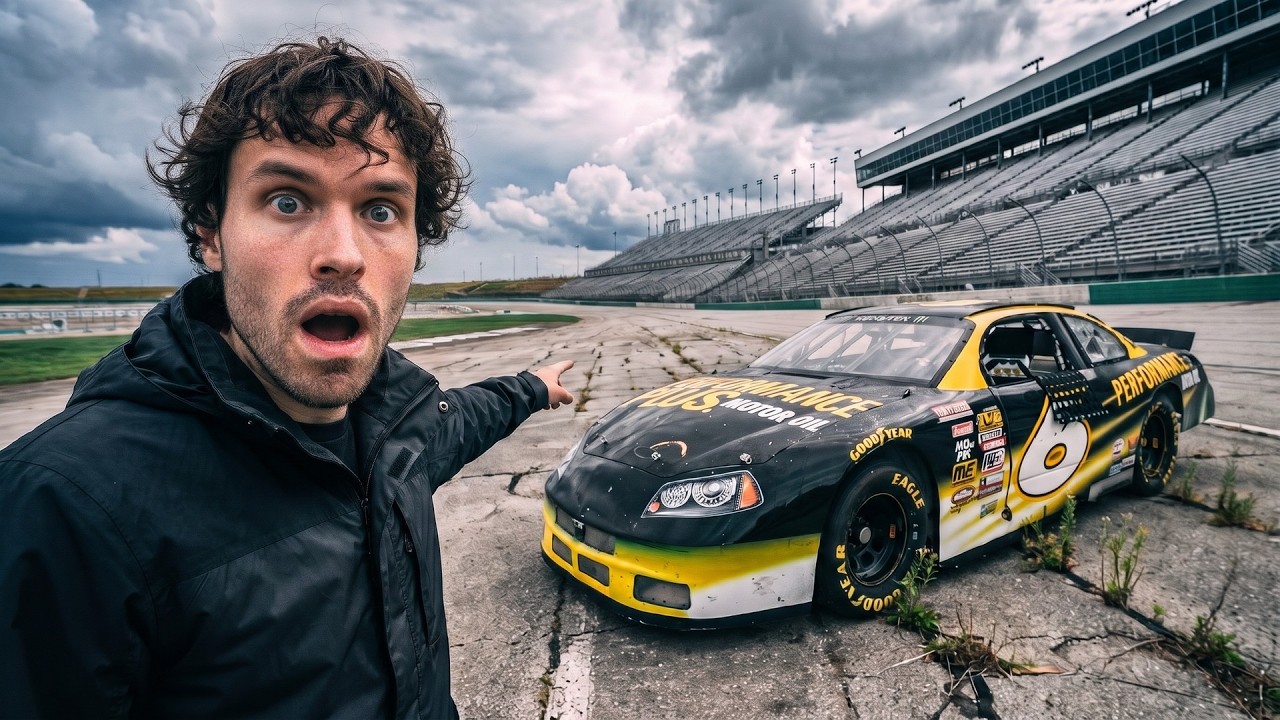
, exact location withheld
DJI Osmo Action 5 Pro vs GoPro for Abandoned Buildings
The DJI Osmo Action 5 Pro against the GoPro Hero 13 Black and Insta360 Ace Pro 2 for dark buildings, compared on sensor, cold battery, storage and mic.
For dark abandoned buildings, I film on the DJI Osmo Action 5 Pro because of its 1/1.3-inch sensor, a cold weather battery rating, 47 GB of built in storage and a mic that links straight to the camera. The GoPro Hero 13 Black and Insta360 Ace Pro 2 are good cameras, and each one wins on something.
A quick disclosure. The DJI Osmo Action 5 Pro (Adventure Combo) and DJI Mic 3 are what I carry and link to, and my Amazon links are affiliate links that earn me a commission if you buy through them. The GoPro and Insta360 links go to their makers.
What does an abandoned building ask of a camera?
Less than you’d think, and different things than a ski trip. No power is the first problem. Even where there is some, as in the pedestrian tunnel under Kentucky Speedway, most rooms are dark and the light you bring is the only one. Add dust, a day that runs long, cold when the heat has been off for years, and a bag with everything in it.
That gives five tests:
- Sensor and low light. A bigger sensor gathers more light in a dark room.
- Battery, especially cold. A dead battery in the middle of a long walk ends the footage.
- Storage. A full or failed card shouldn’t end the day.
- Mounting. You change from chest to hand to pole without thinking.
- Audio. Empty buildings echo, and the camera mic hears wind and your own steps.
Everything below is the makers’ own claim from the pages listed at the bottom, as of Nov 1, 2026. I haven’t run lab tests, and I’m not claiming any footage here is better than another camera’s.
How do the three cameras compare on paper?
| DJI Osmo Action 5 Pro | GoPro Hero 13 Black | Insta360 Ace Pro 2 | |
|---|---|---|---|
| Sensor | 1/1.3-inch CMOS | Not listed on the pages I opened (Hero 12: 1/1.9-inch) | 1/1.3-inch |
| Top 4K frame rate | 4K at 120 fps | 4K at 120 fps | 4K at 120 fps (slow motion) |
| Other top modes | 4K at 120 in 16:9 and 4:3 | 5.3K at 60 fps | 8K at 30 fps |
| Low light claim | SuperNight, at 24 to 60 fps | Night Effects (light trails, star trails), no named low light video mode | PureVideo |
| Stabilization | RockSteady 3.0, HorizonSteady | HyperSmooth 6.0 | FlowState |
| Battery | 1,950 mAh, 4 h at 25°C (lab, 1080p24) | 1,900 mAh, 1.5 h at 4K30 | 1,800 mAh, 3 h at 1080p (lab, Endurance Mode) |
| Cold claim | 3.6 h at -20°C (lab), operating range -20 to 45°C | Enduro battery full function down to 14°F (-10°C) | Operating range -4 to 113°F (-20 to 45°C) |
| Built in storage | 47 GB usable (64 GB total) plus microSD | None, microSD | None, microSD |
| Mount | Magnetic quick release adapter | Magnetic Latch (sold separately) | Magnetic mount system |
| Screens | 1.46-inch front, 2.5-inch rear | Not listed on the pages I opened | 2.5-inch flip touchscreen |
| Waterproof, no case | 20 m | 33 ft (10 m) | 12 m |
| Mic link | DJI Mic 3 direct to camera | Bluetooth mics, Media Mod 3.5 mm port | Bluetooth list excludes Mic 3 |
| Price tier | $300 to $400 | $350 to $450 | $350 to $450 |
Prices are tiers from the makers’ pages and retailer listings, and bundles move them.
Why do I pick the Osmo Action 5 Pro for dark buildings?
The sensor. DJI lists a 1/1.3-inch CMOS sensor with a 2.4 μm pixel size, f/2.8 and ISO up to 51,200 for video. GoPro’s own Hero 12 page lists a 1/1.9-inch sensor, and the Hero 13 pages I opened give no sensor size. A bigger sensor is a spec, not a promise, but in a dark room it’s the spec I want. The Insta360 matches DJI’s size, so on sensor alone it’s a tie.
SuperNight. DJI’s mode adds AI noise reduction for dark scenes and covers 4K, 2.7K and 1080p at 24 to 60 fps. It isn’t available at 100 or 120 fps, so slow motion in the dark is still a weak spot. Per DJI’s FAQ, SuperNight is meant for darker urban night scenes, not a pitch black basement, which is where the light comes in.
The cold. Buildings with the heat off sit at outdoor temperature. DJI says the camera records for up to 3.6 hours at -20°C, with the caveat that it’s a lab figure at 1080p24 with Wi-Fi and screens off. The standard figure is up to 4 hours at 25°C, so the cold rating costs it very little on paper. GoPro’s Enduro battery page says it keeps full functionality down to 14°F (-10°C), a milder claim, and GoPro doesn’t publish a cold runtime. Insta360 lists the same -20°C operating range as DJI but no cold runtime.
Built in storage. The Action 5 Pro has 64 GB of built in storage with 47 GB usable, per DJI’s spec sheet, on top of a microSD slot that takes up to 1 TB. I treat it as a backup. If a card fails or I forget one, the camera still records. GoPro and Insta360 both say microSD only.
The mic link. The DJI Mic 3 transmitter connects straight to the Action 5 Pro with no receiver, via DJI’s OsmoAudio link, and the camera takes up to two transmitters. DJI lists 48 kHz, 24-bit audio on that link. The transmitter can also record 32-bit float to its own 32 GB of storage. That matters in a building where a voice bounces off every wall.
The kit. My Adventure Combo has three batteries and a 1.5 m extension rod. DJI’s store page lists two additional Extreme Battery Plus cells and the rod. Three batteries is a long day’s worth, and the rod gets the camera over a railing or up a stairwell.
Where is the DJI weaker?
- SuperNight tops out at 60 fps. No 100 or 120 fps in that mode.
- The cold battery figure is a lab test. DJI says so itself, and the page marks it “for reference only.”
- The mic combo needs the right mic. Mic 3 goes direct on the DJI. On the Insta360 it doesn’t, as I’ll get to.
- Waterproofing. 20 m is the best of the three, but I’m not filming in water.
- Price. DJI’s own pages disagree on the Adventure Combo. Its store page lists $419 for it, the announcement page $449. Check at checkout.
Where does the GoPro win?
The Hero 13 Black’s case is the system around it. GoPro’s Hero 13 announcement lists 5.3K at 60 fps, 4K at 120, HyperSmooth, and four HB-Series lenses (Ultra Wide, Macro, Anamorphic and ND Filter) that work with HyperSmooth. The DJI and Insta360 pages I opened list no swappable lenses. The Magnetic Latch uses magnets to line up the camera and auto engaging dual latches to hold it, and GoPro says it works with all GoPro mounts.
Its stabilization reputation is real too. HyperSmooth 6.0 is the version on both the Hero 12 and Hero 13 pages, and a lot of people trust it for footage that moves. I can’t tell you how it compares frame for frame in a dark hallway, because I haven’t shot that comparison.
On audio, GoPro is a different route, not a worse one. Its Wireless Mic kit’s transmitter connects directly by Bluetooth to a Hero 13 Black, though GoPro notes Bluetooth supports one transmitter at a time. The kit’s receiver goes through the Media Mod’s mic port, and the Media Mod adds a directional mic, a 3.5 mm input and cold shoe mounts. More parts, more choices.
The Hero 13 Black’s own page lists a 1,900 mAh battery and “more than 2.5 hours” at 1080p30 or “over 1.5 hours” at 4K30. The DJI’s lab figure of 4 hours is at 1080p24, so the two aren’t a clean comparison. At 4K30 the GoPro’s number is the only one that’s published.
GoPro has also moved on. The MISSION 1 series, announced in 2026 with a 1-inch sensor, starts around $600 at list price, and GoPro’s own pages put the Hero 13 Black at about $400. I’m comparing the Hero 13 because it’s the one most explorers will actually weigh against the DJI.
Where does the Insta360 win?
The Ace Pro 2 is the DJI’s closest match on paper. It has a 1/1.3-inch 8K sensor, and Insta360 lists PureVideo, which it says “drastically reduces noise and enhances details in real time” even in extreme low light. DJI’s SuperNight and Insta360’s PureVideo both target noise in dark footage, and neither maker publishes a test that picks a winner. If you want 8K at 30 fps, only the Insta360 has it.
It also has a 2.5-inch flip screen, a magnetic mount system, a 12 m waterproof rating and fast charging, with 80% in 18 minutes, per Insta360.
Two things hold it back for me. It has no internal storage, and its 1,800 mAh battery is listed at 180 minutes at 1080p24. The bigger one is the mic. Insta360’s Bluetooth compatibility list names the DJI Mic, Mic 2 and Mic Mini as supported, and lists the DJI Mic 3 as not supported. If you already own a Mic 3, that rules the Ace Pro 2 out.
What about the GoPro Hero 12?
GoPro’s Hero 12 Black page lists a 1/1.9-inch sensor, 5.3K at 60 fps, 4K at 120, a 1,720 mAh battery and an operating range of -10 to 35°C. The page lists built in folding mounting fingers, not a magnetic latch, and shows no price. It’s the pick if you find one cheap and don’t need the Hero 13’s bigger battery. For low light in cold buildings, its sensor and temperature range are both a step behind the cameras above.
What matters more than the camera?
Light and sound. Footage from any of these three is only as good as what’s in front of the lens. A bigger sensor helps in a dark room, but it can’t find a hallway nobody lit, and no camera mic fixes a voice bouncing around concrete. A strong light makes the camera’s job easier, and I wrote up the ten flashlights I compared, including the Coast XP11R I carry, because most flashlights, including brand ones, aren’t bright enough. Clean audio is the other half, and that’s why the mic is on the list.
If you’re choosing between the cameras, choose the one whose mic, mounts and batteries fit what you already own.
Where to find the places is a different question, and my PDF, How to Find Abandoned Places, covers it.
If you want the spec sheets yourself, the makers’ pages are GoPro Hero 13 Black (Amazon search), GoPro Hero 12 Black (Amazon search) and Insta360 Ace Pro 2 (Amazon search).
What I carried in
Same list as every video description.
Sources
- Osmo Action 5 Pro specs, DJI
- Osmo Action 5 Pro announcement, DJI
- Osmo Action 5 Pro FAQ, DJI
- Osmo Action 5 Pro, DJI Store
- Action cameras, DJI Store
- Osmo Action Quick-Release Adapter Mount, DJI Store
- DJI Mic 3, DJI Store
- DJI Mic 3 FAQ, DJI
- Wireless microphones for Osmo Pocket and Action, DJI
- HERO13 Black, GoPro
- HERO13 Black announcement, GoPro
- Enduro Battery (HERO13 Black), GoPro
- Magnetic Latch Mount, GoPro
- Media Mod, GoPro
- Wireless Mic Complete Kit, GoPro
- HERO12 Black, GoPro
- MISSION 1 Series pricing, GoPro investor relations
- Ace Pro 2 announcement, Insta360
- Ace Pro 2 store page, Insta360
- Ace Pro 2 FAQ, Insta360
- Ace Pro 2 Bluetooth device compatibility, Insta360 manual
More like this


The footage that never goes public lives on Patreon. It's paid, and it's where the rough cuts, the security run-ins and the early releases go.